


NABL Test Report for Anti-Pigmentation 2% Kojic Acid Serum
Anti-Pigmentation 2% Kojic Acid Serum: NABL Lab Test Report
NABL lab test report for Anti-Pigmentation 2% Kojic Acid Serum: heavy metals not detected at stated detection limits and pH 4.95. Batch CC6B020.
Safety Summary: Anti-Pigmentation 2% Kojic Acid Serum
Is Anti-Pigmentation 2% Kojic Acid Serum laboratory tested? Yes. It was independently tested at Sigma Test & Research Centre, a laboratory accredited by NABL (Accreditation No. TC-15193). The tested sample, from batch CC6B020, was analysed for the parameters listed in the reports.
Heavy metals not detected. The report found lead, cadmium, arsenic and antimony below the laboratory's detection limit of 0.25 mg/kg, and mercury below its detection limit of 0.1 mg/kg.
Microbial counts within limits. Total microbial count was less than 10 cfu/g (limit NMT 1000 cfu/g); total yeast & mould count was less than 10 cfu/g (limit NMT 100 cfu/g).
Measured pH. The laboratory recorded a pH of 4.95.
Sulphate-free and paraben-free. The referenced published ingredient list contains no sulphates, parabens, silicones or mineral oil. Preservation uses ethylhexylglycerin and phenoxyethanol.
Is it chemical-free? No cosmetic is chemical-free; water itself is a chemical. The laboratory report records specific contaminants below their stated detection limits rather than proving complete absence of chemicals.
What these results cover. The laboratory findings apply to the tested sample from batch CC6B020 and the parameters listed on this page. Skin tolerance is assessed separately in the dermatological patch test certificate. NABL accredits laboratories, not products.
Key Findings at a Glance
Results of Analysis
Result is the measured outcome for this batch. Requirement / Limit is the specification where the standard defines one; a dash means it defines none. Test Method is the standard the laboratory followed.
| Parameter | Result | Requirement / Limit | Test Method |
|---|---|---|---|
| Physical & Organoleptic | |||
| Appearance | Yellow coloured viscous liquid | - | STRC/STP/F256 |
| Colour | Yellow | - | STRC/STP/F256 |
| Odour | Characteristic | - | STRC/STP/P044 |
| Chemical Parameters | |||
| pH | 4.95 | - | STRC/STP/P077 |
| 1,4 Dioxane, mg/kg | Not Detected (DL 10.0) | - | Indian Pharmacopoeia (Chapter No. 2.4.40) |
| Density, g/ml | 1.012 | - | Indian Pharmacopoeia 2022 |
| Total residue, % w/w | 6.05 | - | IS:6608:2004 |
| Heavy Metals | |||
| Lead (as Pb), mg/kg | Not Detected (DL 0.25) | - | STRC/STP/P018 |
| Cadmium (as Cd), mg/kg | Not Detected (DL 0.25) | - | STRC/STP/P018 |
| Arsenic (as As), mg/kg | Not Detected (DL 0.25) | - | STRC/STP/P018 |
| Mercury (as Hg), mg/kg | Not Detected (DL 0.1) | - | STRC/STP/P018 |
| Antimony (as Sb), mg/kg | Not Detected (DL 0.25) | - | STRC/STP/P018 |
| Microbial Counts | |||
| Total microbial count, cfu/gm | Less than 10 | NMT 1000 | IS:14648:2011 |
| Total yeast & mould count, cfu/gm | Less than 10 | NMT 100 | IS:14648:2011 |
Understanding These Tests for Anti-Pigmentation 2% Kojic Acid Serum
Physical & Organoleptic
On the tested sample, Anti-Pigmentation 2% Kojic Acid Serum was recorded as a yellow coloured viscous liquid, yellow in colour, with a characteristic odour.
These checks record what the laboratory observed in the sample as received.
Chemical Parameters
The report lists pH 4.95, 1,4-dioxane not detected (DL 10.0 mg/kg), density 1.012 g/ml and total residue 6.05% w/w.
Chemical parameters are measured against the standard's specification where one exists.
Heavy Metals
In this report, Anti-Pigmentation 2% Kojic Acid Serum showed no detectable lead, cadmium, arsenic, mercury or antimony at their stated detection limits (0.25 mg/kg for lead, cadmium, arsenic and antimony; 0.1 mg/kg for mercury).
Heavy metals can enter a product through raw materials or manufacturing.
Microbial Counts
Anti-Pigmentation 2% Kojic Acid Serum recorded total microbial count less than 10 cfu/gm against a limit of NMT 1000 cfu/gm and total yeast & mould count less than 10 cfu/gm against a limit of NMT 100 cfu/gm.
These tests count viable microorganisms against the limits set by the standard.
Test Overview
| Report Title | Chemical and Microbiological Analysis - Anti-Pigmentation 2% Kojic Acid Serum |
| Parameters Measured | Physical and organoleptic properties, chemical parameters, heavy metals and microbial counts |
| Test Type | Laboratory chemical and microbiological analysis of a product sample |
| Test Methods | Indian Pharmacopoeia 2022; IS:6608:2004; IS:14648:2011 |
| Sample Tested | CC6B020 (30 ml x 3) |
About Anti-Pigmentation 2% Kojic Acid Serum
Buy The Derma Co 2% Kojic Acid Face Serum with Alpha Arbutin & Niacinamide. Reduces Pigmentation, Fades Spots & Evens Skin Tone. Designed by Dermatologists.
Claims and Their Evidence
Lab-sourced rows are measured results. Product-page rows are the brand's own claims, shown with the brand's qualifier. The laboratory report is not evidence for cosmetic-benefit claims.
| Statement | Evidence / basis | Source |
|---|---|---|
| Heavy metals not detected at stated detection limits | Lead, cadmium, arsenic and antimony reported Not Detected at DL 0.25 mg/kg; mercury at DL 0.1 mg/kg. | Lab report 13047001/Z |
| Within microbiological limits | Total microbial and yeast/mould counts less than 10 cfu/g and within specified limits; pathogen results not included. | Lab report 13047001/Z |
| 2% Kojic Acid Face Serum with Alpha Arbutin & Niacinamide | Brand claim published on the product page. | Product page (brand claim) |
| Sulphate-free cleansing base | Formulated with epigallocatechin gallatyl glucoside in place of SLS/SLES. | Product ingredient list |
| Paraben-free | No parabens in the published ingredient list. | Product ingredient list |
Report Details
| Testing Laboratory | Sigma Test & Research Centre (NABL-accredited, Accreditation No. TC-15193) |
| ULR Number | TC1519326000001968F |
| Report No. | 13047001/N, 13047001/Z |
| Report Issue Date | 10/03/2026 |
| Testing Period | 27/02/2026 to 09/03/2026 |
| Batch Tested | CC6B020 (Mfg. 02/2026; use before 24 months) |
| Standards Referenced | Indian Pharmacopoeia 2022; IS:6608:2004; IS:14648:2011 |
| Authorised Signatory | Shruti Vij, Technical Manager, Sigma Test & Research Centre |
What This Report Shows
What the results demonstrate
- Physical characteristics of the tested sample were recorded as observed by the laboratory.
- Measured chemical parameters were documented using the reported methods.
- The listed heavy metals were below the laboratory's detection limits in the tested sample.
- The tested sample met the microbiological count limits of the referenced standard.
- Testing was performed by an NABL-accredited laboratory.
What the results do not demonstrate
- They do not certify the product; NABL accredits laboratories, not products.
- They do not establish overall safety or suitability for every individual.
- They do not prove cosmetic-benefit or performance claims.
- They do not cover parameters or organisms outside those listed.
- They apply to the tested sample from the stated batch, not necessarily to other batches.
Formulation at a Glance
From the ingredient list published on the product page. Not part of the laboratory report.
Active Ingredients
| Component | Role in the formulation |
|---|---|
| Kojic Acid | Kojic acid derivative used in tone-focused formulas. |
| Niacinamide | Vitamin B3 derivative used for tone and barrier support. |
| Alpha Arbutin | Arbutin, used in tone-focused formulas. |
| Sodium PCA | Natural moisturising factor that holds water in the skin. |
| Panthenol (Vitamin B5) | Pro-vitamin B5 humectant supporting moisture and elasticity. |
| Sodium Hyaluronate (Hyaluronic Acid) | Salt of hyaluronic acid; binds water for hydration. |
Moisturising and Emollient
| Component | Role in the formulation |
|---|---|
| Propanediol | Humectant and solvent that improves texture. |
| Pentylene Glycol | Humectant that also supports preservation. |
| Glycerin | Humectant that draws water into the skin surface. |
Texture and Stability
| Component | Role in the formulation |
|---|---|
| Aqua (Water) | Solvent base of the formulation. |
| Silica | Mineral powder that absorbs oil and adds a soft-focus finish. |
| Disodium EDTA | Chelating agent that stabilises the formula against metal ions. |
| Trisodium Ethylenediamine Disuccinate | Readily biodegradable chelating agent. |
| Citric Acid | Adjusts the pH of the formulation. |
Preservative System
| Component | Role in the formulation |
|---|---|
| Phenoxyethanol | Broad-spectrum preservative used at low levels. |
Colourants
| Component | Role in the formulation |
|---|---|
| CI 19140 | Approved cosmetic colourant. |
What the Formulation Leaves Out
| Excluded | Basis |
|---|---|
| No sulphates | Not present in the published ingredient list. |
| No parabens | Not present in the published ingredient list. |
| No silicones | Not present in the published ingredient list. |
| No mineral oil | Not present in the published ingredient list. |
Published Research on Key Actives
Published literature on each ingredient, not studies on this product.
| Ingredient | Published finding | Relevance to the formulation |
|---|---|---|
| Niacinamide | Topical niacinamide has been reported to improve the appearance of ageing facial skin, including tone and texture (Bissett DL, et al. Dermatol Surg. 2005;31(7 Pt 2):860-865). | Supports the inclusion of niacinamide in tone and barrier formulas. |
| Hyaluronic Acid | Hyaluronic acid is documented as a key water-binding molecule in skin hydration (Papakonstantinou E, et al. Dermatoendocrinol. 2012;4(3):253-258). | Supports hyaluronic acid or sodium hyaluronate as a hydrating agent. |
| Panthenol (Pro-Vitamin B5) | Topical dexpanthenol is documented to support hydration and barrier function (Proksch E, et al. Am J Clin Dermatol. 2009;10(6):359-367). | Supports panthenol for moisture retention and elasticity. |
Dermatological Patch Test Certificate
This NABL lab test report covers the chemical and microbiological analysis of Anti-Pigmentation 2% Kojic Acid Serum. Skin tolerance is a separate question, assessed through dermatological patch testing. The dermatological patch test certificate for this product is published on its own page, so you can review the laboratory analysis here and the patch-test findings there as one trust cluster.
View the Original Lab Report
The complete original report for Anti-Pigmentation 2% Kojic Acid Serum is available as issued by the laboratory. It carries the laboratory letterhead, the ULR number, and the authorised signatory's details.
The Tested Product
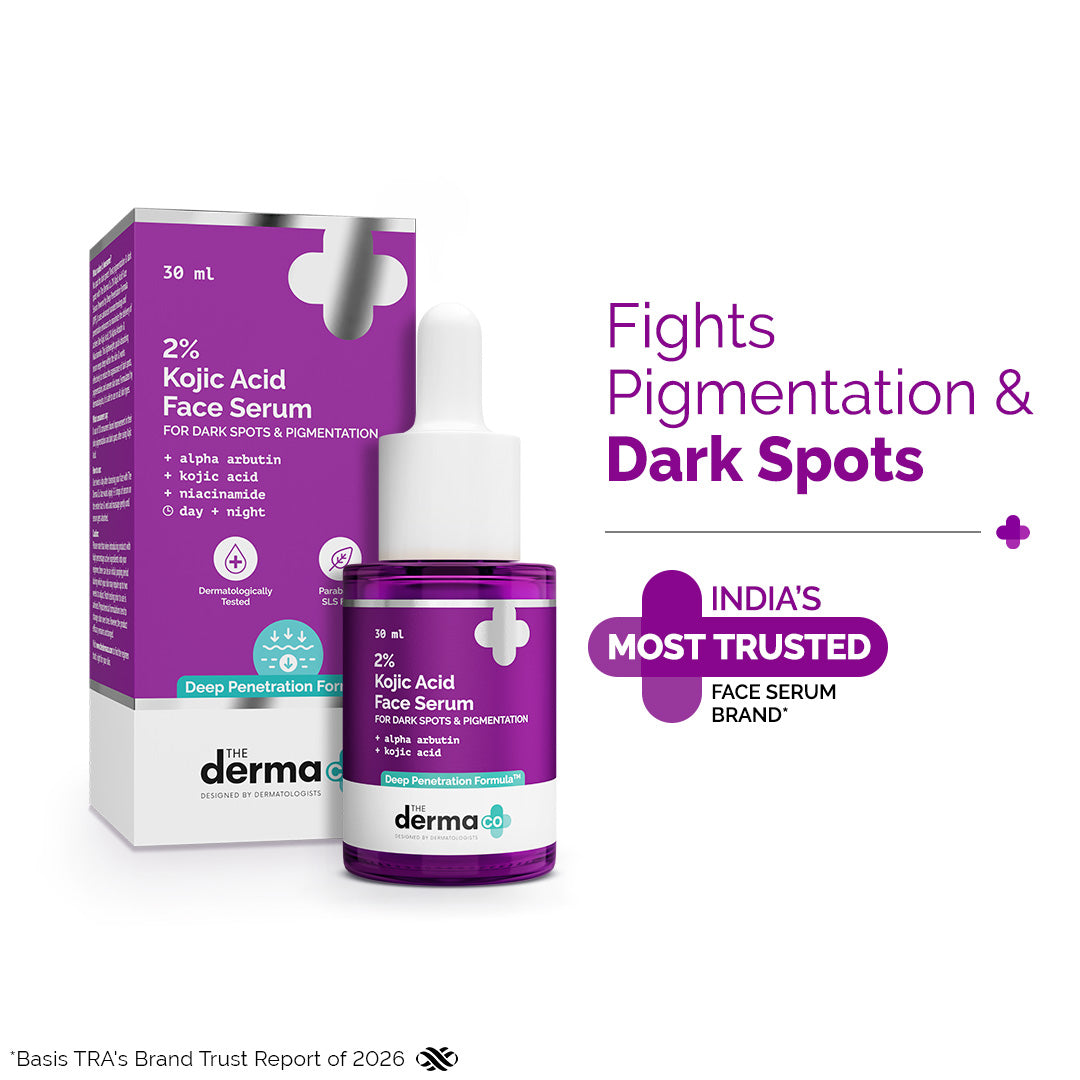
Anti-Pigmentation 2% Kojic Acid Serum
The results on this page come from laboratory testing of a sample from batch CC6B020. See the complete ingredient list, current offers and reviews on the product page. Learn more about Kojic Acid. You can also explore the full product range or other products in this category.
View ProductFrequently Asked Questions
A: Yes. In this report, lead, cadmium, arsenic and antimony were not detected at 0.25 mg/kg, and mercury was not detected at 0.1 mg/kg at Sigma Test & Research Centre, an NABL-accredited laboratory (Accreditation No. TC-15193).
A: For the tested batch, microbial counts were reported within the limits of the referenced standard and the supplied report does not list pathogen test results. These results indicate the tested sample met the referenced microbiological limits; they do not establish overall product safety.
A: The measured pH in this report is 4.95.
A: The published ingredient list for this product contains no sulphates, parabens, silicones or mineral oil. This is based on the ingredient list, not on the laboratory report, which covers contaminants and microbiological quality.
A: No. The report covers physical, chemical and microbiological parameters on a sample from the stated batch. Performance and cosmetic-benefit claims are made by the brand on the product page and are not part of this laboratory report.
A: It means the substance was below the laboratory's stated detection limit using the specified method, so it was not found at or above that limit in the tested sample.
A: A ULR (Unique Lab Report) number is a laboratory report identifier printed on test certificates. The ULR for this report is TC1519326000001968F. The original report PDF linked on this page carries the laboratory letterhead and authorised signatory details.
A: No. NABL accredits laboratories, not products. This page reports the results of testing performed at Sigma Test & Research Centre, an NABL-accredited laboratory (Accreditation No. TC-15193) on a sample of this product. It does not represent a product certification by NABL.
A: The report covers batch CC6B020 (manufactured 02/2026). The laboratory report states the tested sample as 30 ml x 3. Results refer only to the tested sample and the parameters listed.
References
- Indian Pharmacopoeia 2022. Indian Pharmacopoeia Commission.
- IS:6608:2004. Bureau of Indian Standards.
- IS:14648:2011. Bureau of Indian Standards.
- Sigma Test & Research Centre. Test reports 13047001/N, 13047001/Z.


