


Kojic acid face washes are increasingly recommended by dermatologists as a practical first step in a brightening routine. They deliver active depigmenting ingredients at the cleansing stage without adding another leave-on layer. Whether you are dealing with dark spots and hyperpigmentation, uneven skin tone, or post-tan dullness, a well-formulated kojic acid cleanser addresses these concerns with every daily wash. This guide covers how they work, the key benefits for skin, how to use one correctly in your daily routine, and which products dermatologists recommend for Indian skin.
Quick Answer
- Benefits of kojic acid face wash include fading dark spots, reducing post-acne marks, brightening dull complexion, de-tanning, and daily oil control
- Works by inhibiting tyrosinase, the enzyme responsible for excess melanin production
- Suitable for all skin types including oily, dry, combination, and sensitive at 1% concentration
- Safe for daily morning and evening use; pairs well with leave-on brighteners and SPF
- Expect visible glow improvements in 2–4 weeks; dark spot fading in 8–12 weeks of consistent twice-daily use
Why Use Kojic Acid in a Face Wash Format?
Most people encounter kojic acid as a leave-on product: a serum, cream, or toner. A face wash delivers the same active at the cleansing step, which has a distinct practical logic that leave-on formats do not replicate.
It replaces an existing step rather than adding a new one. You are already washing your face twice a day. Switching to a kojic acid face wash introduces the active without changing your routine structure at all. This is the most accessible starting point for anyone building a brightening routine, especially if you are not ready to layer multiple leave-on actives at once.
The twice-daily rhythm also compounds differently than an occasional leave-on. A serum sits at higher concentration for hours; a face wash delivers at lower concentration but reliably with every cleanse. For post-acne marks and melasma, where consistent daily inhibition of tyrosinase matters more than peak concentration in any one session, this steady accumulation over 8 to 12 weeks adds up meaningfully.
There is also a preparation benefit. The cleansing action that removes sebum, sunscreen residue, and environmental buildup also removes the surface barriers that reduce how much your leave-on serums actually absorb. A kojic acid face wash delivers its own active and simultaneously prepares cleaner skin for better uptake of everything applied after it.
How to Use Kojic Acid Face Wash in Your Daily Routine
Morning and evening is the target frequency. The technique matters more than most people assume for an active cleanser.
Morning
Wet your face with lukewarm water. Dispense a small amount of the face wash, lather it between your palms first, then massage gently across the face in circular motions for 30 to 60 seconds. That contact window is what differentiates a brightening cleanser from a plain one; the active ingredients need brief but consistent skin exposure before rinsing. After rinsing thoroughly, pat dry. Follow with a serum, then moisturiser, then SPF 30+ PA+++. Sunscreen is not optional. Kojic acid reduces the skin's melanin defence response, so unprotected UV exposure continuously re-triggers melanin production and undoes visible progress. Without SPF, the brightening does not accumulate.
Evening
Use the same face wash to remove the day's sunscreen, sebum, and buildup. The cleansed surface absorbs leave-on actives more effectively, so apply your most targeted treatment here: a kojic acid serum or leave-on treatment from the kojic for skin range, an alpha arbutin concentrate, or retinol on alternate nights for those targeting deep or stubborn pigmentation. Finish with a night moisturiser.
First-Time Users
Start with once-daily evening use for the first two weeks. If no redness, tightness, or irritation develops, add the morning step from week three. Do not combine a physical scrub and a kojic acid face wash in the same session; the combination over-sensitises the barrier. Alternate the scrub to separate days instead.
What to Pair with Kojic Acid Face Wash
The face wash is most effective when the actives that follow it address the same pigmentation pathway from a different angle. In the morning, a niacinamide serum after washing extends the niacinamide action already present in the cleanser into a full leave-on window. Niacinamide blocks the transfer of melanin from melanocytes to skin cells, which complements kojic acid's upstream tyrosinase inhibition. Together they target pigmentation from both the production side and the distribution side. SPF 30+ PA+++ follows every morning without exception.
In the evening, after cleansing, an alpha arbutin serum or a kojic acid leave-on treatment adds a second, longer-duration active contact window during overnight skin repair. For those dealing with deep or established dark spots, adding retinol on alternate evenings supports faster cellular turnover, which moves treated melanin out of the skin more quickly. These three steps together, face wash, serum, and SPF, form the core of a dermatologist-recommended brightening routine.
What to avoid pairing on the same session: AHA or BHA exfoliating toners. If glycolic acid or salicylic acid are part of your routine, use them on separate evenings to avoid cumulative barrier disruption. Both actives work better given their own session.
Kojic Acid Face Wash for Which Skin Type?
At 1% concentration, a kojic acid gel face wash suits all skin types when the formula is right. Oily and combination skin benefits from the gel format's efficient sebum removal and the pore-tightening effect of niacinamide. Dry skin needs a formula with glycerin, sodium PCA, and glyceryl glucoside to prevent tightness after cleansing; check the ingredient list before buying. Sensitive skin does well with fragrance-free, dermatologist-tested options at this concentration, though a patch test on first use is always sensible. Kojic acid face wash is not recommended during pregnancy.
Watch: Kojic Acid Face Wash | Dark Spots & Pigmentation | The Derma Co

Best Kojic Acid Face Washes in India
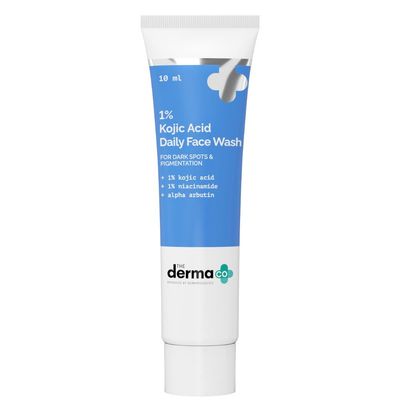
The Derma Co 1% Kojic Acid Face Wash with Niacinamide & Alpha Arbutin (100 ml)
MRP: ₹549
Best suited for: Daily brightening, post-acne marks, dark spots, melasma, all skin types including sensitive
The Derma Co 1% Kojic Acid Face Wash delivers three depigmenting actives in a daily rinse-off step. Kojic Acid Dipalmitate inhibits tyrosinase at the cleansing stage, while alpha arbutin adds a second melanin-blocking pathway. Niacinamide addresses post-acne redness, visible pores, and surface texture simultaneously. Supporting ingredients, glycerin, sodium PCA, date palm extract, and glyceryl glucoside, maintain skin hydration through the cleanse. Fragrance-free, dermatologist-tested, pH 5–6.
- Kojic Acid Dipalmitate inhibits tyrosinase, reducing melanin synthesis at the cleansing step
- Alpha arbutin provides a complementary depigmentation pathway alongside kojic acid
- Niacinamide addresses post-acne marks, pore appearance, and surface redness
- Glycerin, sodium PCA, and glyceryl glucoside maintain hydration balance with daily use
- Balanced pH 5–6 preserves skin barrier integrity through morning and evening cleansing
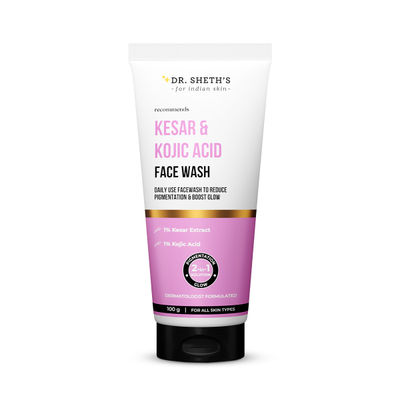
Dr. Sheth's Kesar & Kojic Acid Face Wash (100 g)
MRP: ₹262
Best suited for: Combination and oily skin, budget-conscious shoppers, first-time kojic acid users
Dr. Sheth's Kesar & Kojic Acid Face Wash pairs kojic acid with kesar (saffron) extract, a traditional Indian brightening ingredient with documented antioxidant and free-radical scavenging properties. Niacinamide, hyaluronic acid, and sodium PCA complete the formula to prevent dryness during cleansing. A practical entry point for those testing kojic acid benefits before committing to a leave-on treatment, or for those who prefer a blend of clinically studied and traditional brightening actives.
- Kesar (saffron) extract adds traditional brightening activity with antioxidant properties alongside kojic acid
- Niacinamide targets post-acne marks, pore appearance, and surface redness
- Hyaluronic acid and sodium PCA maintain moisture balance through the daily cleanse
- Gentle enough for morning and evening use across oily, dry, combination, and sensitive skin types
- Sodium PCA provides additional humectant support to prevent over-drying during cleansing
Frequently Asked Questions
Is kojic acid face wash good for oily skin?
Yes, kojic acid face wash is well-suited to oily skin. The gel-format cleanser removes excess sebum efficiently, while niacinamide in most formulations reduces pore appearance and regulates oil production over time. At 1%, kojic acid is non-irritating, and a balanced pH (5–6) formulation will not strip the skin barrier, which would trigger compensatory oil production. Use morning and evening as your regular cleanser.
Kojic acid face wash for which skin type?
At a 1% concentration, kojic acid face wash is suitable for all skin types, oily, dry, combination, and sensitive. Formulas with glycerin, sodium PCA, and glyceryl glucoside are appropriate for dry skin by preventing moisture loss during cleansing. For sensitive skin, look for fragrance-free variants with a pH of 5–6 and dermatologist-testing. The 1% dose is the standard for safe over-the-counter daily use across skin types. It is not recommended during pregnancy.
Does kojic acid face wash remove tan?
Yes, kojic acid addresses UV-triggered pigmentation, which is the primary driver of tanning. By inhibiting tyrosinase, it reduces excess melanin production triggered by sun exposure. With twice-daily use, tan lines fade gradually over 4–8 weeks. However, SPF 30+ PA+++ every morning is essential, UV exposure without protection will continuously re-trigger melanin production and counteract the de-tanning effect.
Can I use kojic acid face wash daily?
Yes, at 1%, kojic acid face wash is formulated for daily morning and evening use. Unlike leave-on actives at higher concentrations, a rinse-off cleanser delivers active ingredients during the cleansing step only, making it well-tolerated for daily use across most skin types including sensitive. If your skin is new to brightening actives, start with once-daily use for the first 1–2 weeks, then increase to twice daily if no irritation occurs.
Which kojic acid face wash is best?
The best choice depends on your concern and skin type. The Derma Co 1% Kojic Acid Face Wash is ideal for those targeting dark spots, post-acne marks, and pigmentation, its triple-active formula with kojic acid, alpha arbutin, and niacinamide covers multiple depigmenting mechanisms in one rinse-off step. Dr. Sheth's Kesar & Kojic Acid Face Wash is a practical option for those who want a traditional-meets-modern brightening formula at a lower price point.
How does kojic acid face wash work?
Kojic acid face wash works by delivering kojic acid, a tyrosinase inhibitor, during the daily cleansing step. Tyrosinase is the enzyme central to melanin synthesis; kojic acid chelates the copper ions in its active site, disrupting melanin production at the source. Applied twice daily as a cleanser, it delivers consistent active contact with the epidermis. Paired with supporting actives like niacinamide and alpha arbutin, the combined effect addresses pigmentation from multiple biochemical angles simultaneously.
What are the advantages of using 1% kojic acid face wash in daily life?
Using a 1% kojic acid face wash daily delivers several compounding advantages: (1) Consistent tyrosinase inhibition, twice-daily contact gradually reduces excess melanin production with every cleanse, which leave-on-only routines cannot replicate. (2) Triple-active coverage, at 1%, kojic acid is typically paired with alpha arbutin and niacinamide, addressing pigmentation from three biochemical angles in a single rinse-off step. (3) Zero added routine steps, a cleanser replaces your existing face wash rather than adding a new layer. (4) Barrier-compatible, balanced pH 5–6 and humectant actives mean daily use does not compromise the skin barrier, unlike some exfoliating brighteners. (5) Foundation for leave-on actives, a well-cleansed surface absorbs subsequent serums and moisturisers more effectively, amplifying the overall brightening result.
Can I use kojic acid face wash with vitamin C or other actives?
Yes, kojic acid face wash is generally compatible with other brightening actives because it is a rinse-off step. Vitamin C serum, niacinamide serum, or alpha arbutin serum applied after cleansing create a layered brightening routine without direct mixing of the actives. One caution: if you are also using leave-on actives with a low pH (such as an L-ascorbic acid vitamin C serum or a mandelic/glycolic acid treatment), apply them after the kojic acid cleanser has been fully rinsed off and the skin has returned to its natural pH. Avoid combining with physical scrubs on the same session, mechanical exfoliation plus an active cleanser can cause over-sensitivity. Always apply SPF 30+ PA+++ every morning when using any brightening active.
How long does kojic acid face wash take to show results?
Results follow a predictable timeline with consistent twice-daily use: Week 1–2: Skin surface feels cleaner and looks slightly brighter, this is primarily from the cleansing and niacinamide effect, not melanin reduction yet. Week 3–4: Dullness reduces and skin tone begins to even out; tan lines may appear lighter. Week 6–8: Dark spots from UV damage and post-acne marks (PIH) begin to visibly fade. Week 8–12: Maximum visible improvement in pigmentation. Consistency is the single biggest factor, skipping days or failing to use SPF will slow or reverse progress. Those with deeper skin tones or established melasma may need 12–16 weeks for significant change.
What happens if I use kojic acid face wash without sunscreen?
Using a kojic acid face wash without SPF significantly reduces the benefit and can worsen pigmentation over time. Kojic acid inhibits melanin synthesis, but UV exposure directly triggers melanin production as a protective response. Without SPF 30+ PA+++ every morning, UV rays continuously re-activate tyrosinase and produce new melanin faster than the kojic acid can suppress it. In practice, this means no visible fading of dark spots, possible worsening of uneven tone, and wasted product. Sunscreen is not optional when using any brightening active. It is the essential second half of the brightening routine.
Can I use kojic acid face wash on my neck and chest?
Yes. The face wash can be extended to the neck and upper chest, which are common sites for UV-triggered pigmentation, uneven tone, and tan lines in Indian skin. Apply it the same way you would on the face: lather, gentle massage for 30 to 60 seconds, rinse thoroughly. These areas tend to be slightly less sensitive than the facial skin, so tolerance is generally similar. Apply SPF to the neck and chest every morning as well if you are using the product on those areas for brightening.
Is kojic acid face wash suitable for men?
Yes, kojic acid face wash works equally well for men. The active ingredients target pigmentation, uneven tone, and dark spots regardless of gender. For men who shave regularly, the same cleanser can be used as a pre-shave wash on clean skin. One point to note: freshly shaved skin is slightly more sensitised, so massaging the face wash gently for a shorter duration (20 to 30 seconds rather than 60) is more comfortable on those days. The brightening and oil-control benefits from niacinamide are particularly relevant for men with oily or combination skin dealing with post-shave marks and sebum buildup.
Should I use hot or cold water with kojic acid face wash?
Lukewarm water is the recommended temperature for washing with a kojic acid face wash. Hot water strips the skin barrier and dilates pores, which can increase sensitivity to the active ingredients. Cold water prevents the face wash from lathering effectively and limits the cleanser's ability to remove sebum and sunscreen residue. Lukewarm water softens the skin surface slightly, supports even lathering, and does not compromise the barrier. Finish with a cool rinse if you prefer, which helps tighten pores after cleansing.
Will kojic acid face wash lighten my natural skin tone?
No. Kojic acid targets excess melanin produced in response to UV exposure, post-acne inflammation, and hormonal changes. It inhibits tyrosinase selectively in the overactive melanocytes producing this excess pigment. Normal baseline melanin in healthy melanocytes is not affected in the same way. The result is a return toward your natural, even skin tone rather than blanching or bleaching. This is why kojic acid is described as a depigmenting or brightening agent rather than a skin lightener. If you notice the surrounding unaffected skin becoming lighter, check your SPF usage and reduce frequency of use.
- Deo K, Sharma YK, et al. "Comparative clinical study of kojic acid and hydroquinone in melasma." Indian J Dermatol, 2013.
- Saeedi M, Eslamifar M, Khezri K. "Kojic acid applications in cosmetic and pharmaceutical preparations." Biomed Pharmacother, 2019.
- Wang J, et al. "Tyrosinase inhibitory activity of kojic acid vs. arbutin types." J Ethnopharmacol, 2022.


